
Sherpa’s Constructor’s Cup Helps More Families Benefit from Assistive Tech
Sherpa’s internal Constructor’s Cup Challenge was established to bring our engineers together to tackle cool problems outside their day-to-day projects. This year, Sherpa partnered with the Child Development & Rehabilitation Center’s (CDRC) Assistive Technology clinic at OHSU Doernbecher, where an interdisciplinary clinical team helps children with disabilities access play and communication through switch-adapted toys and devices.
Designing for access
A key component of their work involves adapting toys and devices for switch access using large, easy-to-activate switches that help children with disabilities participate more independently in play and communication activities. At roughly $75 each, the cost of commercially available switches limits the number of families CDRC can support with adaptive devices. The team at CDRC wanted a low-cost alternative that could be produced internally and shared with families via open source. They reached out to Sherpa to explore a design that could leverage 3D printing and readily available components without sacrificing performance, durability, or safety.
Sherpa engineers and other staff members volunteered for the effort and formed three teams, each developing a different concept for the switch. The friendly competition accelerated ideation and solution development while keeping the goal simple: making a switch that more kids and therapists can access.
At the kickoff, Bethany Sloane (physical therapist), Darrick Stiff (speech-language pathologist), and Erin Cochran (occupational therapist) outlined what the switch had to do:
- Function consistently from all activation angles.
- Be sensitive enough to be activated with a light touch.
- Be compact and safe with rounded edges and no pinch points.
- Adapt to multiple orientations used by therapists and toy modification.
- Be easy for parents, volunteers, and therapists to assemble and repair.
- Minimize or eliminate soldering and be easy to fix, which the current switch did not offer.
- Stay as cost-effective as possible, ideally under $10.
The Sherpa teams approached the challenge by holding brainstorming sessions and then splitting up to develop concepts and work on different components of the switch. Multiple rounds of prototyping to elicit user feedback helped guide the evolution of the switches.
“What I enjoyed most about the process was the iterative design approach,” said Jake Yraceburu, Mechanical Design Engineer at Sherpa Design.
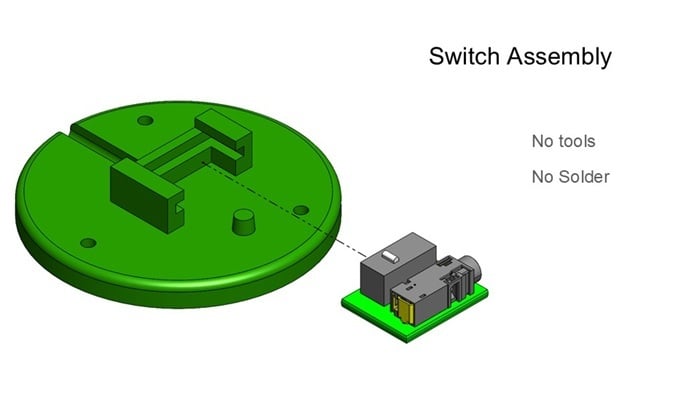 Team 2 Switch Assembly Design
All three teams developed strong solutions to share with the CDRC Assistive Technology team, who reviewed the designs and provided feedback through functional evaluation. The engineers incorporated the best elements from each concept and ultimately converged on a solution that worked best for CDRC and the kids who would use the devices.
“Working with a customer like Doernbecher and Bethany’s team was deeply rewarding,” said Jim Collias, Senior Design Engineer at Sherpa Design.
Our in-house additive team developed the printing strategy that would produce the most consistent results regardless of the person making the parts printing experience. Build orientation, supports, and print parameters were optimized.
Once the CDRC Assistive Technology team decided on the final design, they tested the adaptive switch in-clinic with families and children to see how they would respond.
“Everyone on our team, the kids, and their families have been very happy with it, and we were thrilled with the final product,” explained Bethany (physical therapist from the CDRC team).
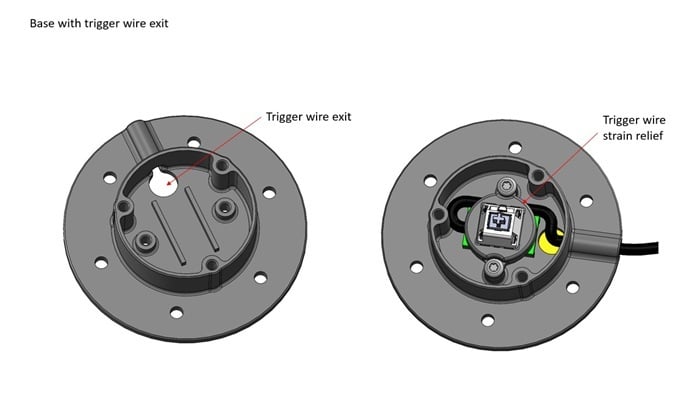 Team 1 Switch Plate Base
The Sherpa Design teams were able to get the price of the switch down to about $10 per unit. They created a manufacturing, sourcing, and assembly guide that the CDRC Assistive Technology team could follow to order PCBs, cabling, and produce the devices themselves. Using clever electronics design and sourcing, the new switch requires no soldering, and parents or volunteers can repair damaged cables easily.
“Working with Sherpa during the design process was a wonderful experience. They brought ideas we never would have thought of, helping make the device truly affordable. I would absolutely work with Sherpa again anytime if given the opportunity,” said Bethany.
.
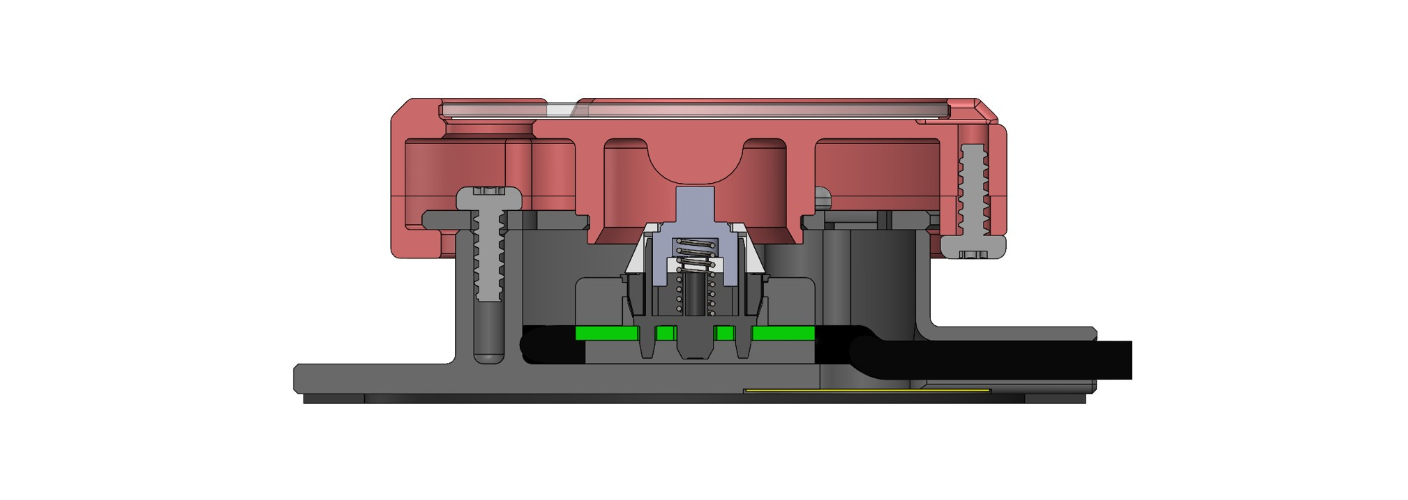
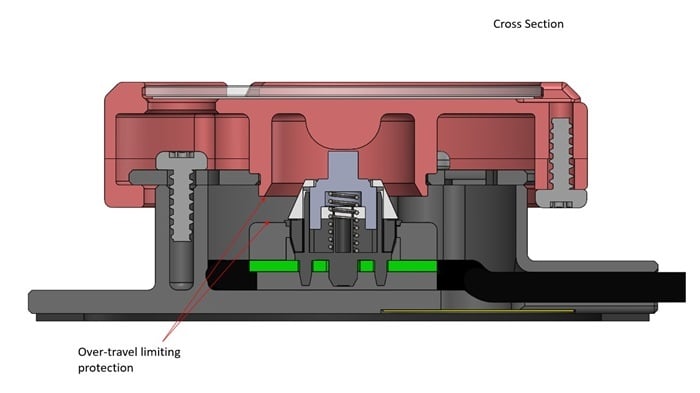 Adaptive Switch Cross Section
SHERPA TEAMS
Team 1
- George Totonchy, IT Systems Administrator
- Nate Ginzton, Senior Design Engineer
- Avi Meyer, Mechanical Design Engineer
- Racheal Gaffney, Administrative Director
- Devin Croswell, Senior Design Engineer - NX Specialist
- Zach McKinney, Additive Manufacturing Technician
Team 2
- Doug Krumpelman Senior Design Engineer – Team Lead
- Jim Collias, Senior Design Engineer
- Chandelle Stanton Mechanical Design Engineer
- Mike Erwin Mechanical Design Engineer
- Tyler Cruz, Additive Manufacturing Technician
- Jon Petersen, Mechanical Design Engineer
Team 3
- John Pruyan, Senior Design Engineer – Team Lead
- Jake Yraceburu, Mechanical Design Engineer
- Alex Danielson, Senior Design Engineer
- Brett Axness, Industrial Designer
- Connor Ray, Additive Manufacturing Technician
- Fernando Ramirez, Mechanical Design Engineer
- Katrena Barker, Administrative Assistant
- Randy Ellsworth Director of Digital Transformation