
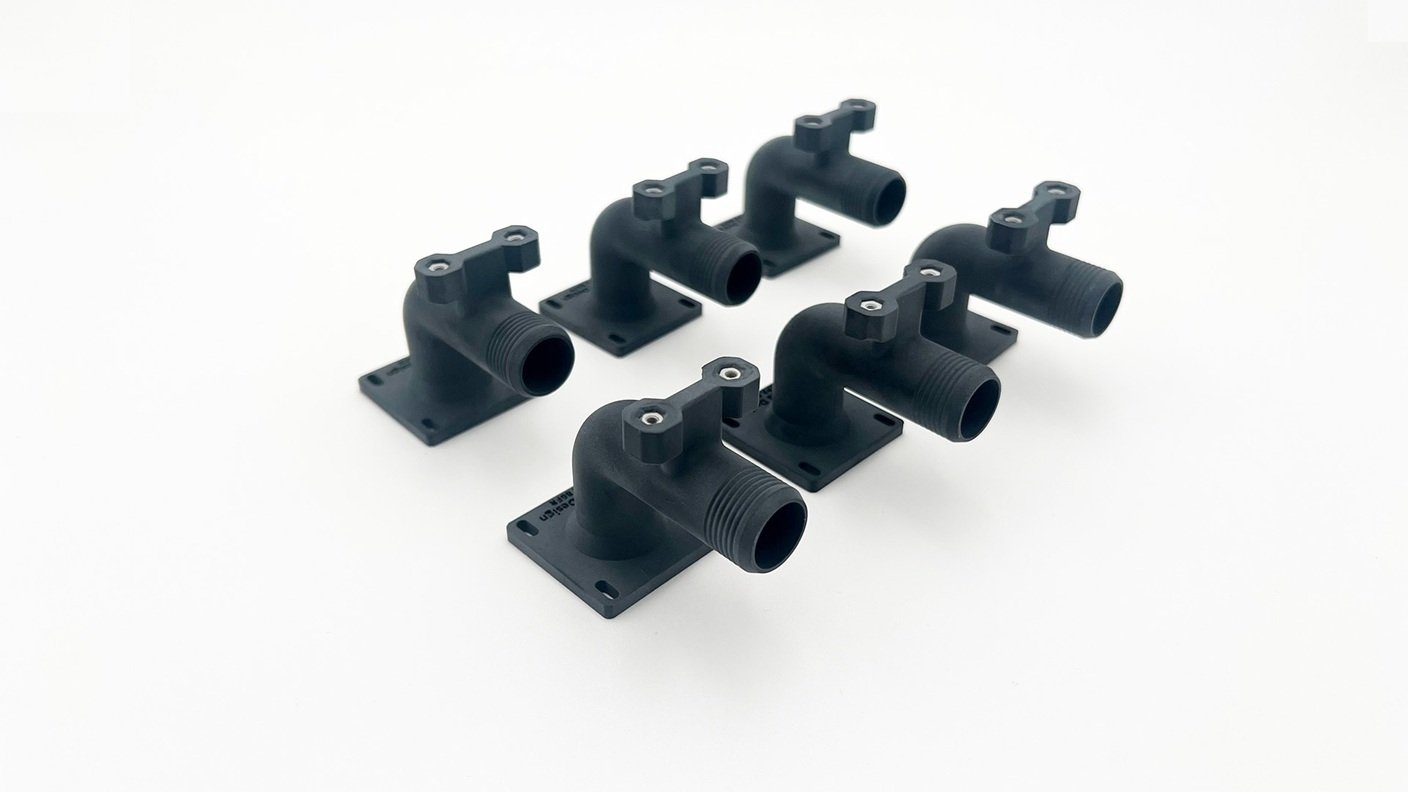
An innovator in the semiconductor industry was looking to create hose and cable management parts using additive manufacturing technology. The parts needed to be rigid, flame retardant, and easily cleaned. These stringent requirements were paramount to prevent fire hazards and contamination within clean room environments, as rigorous decontamination procedures are costly and disruptive.
Finding an additive material that delivered on all these requirements was a challenge. They brought this challenge to Sherpa, and we introduced them to the Carbon’s EPX 86FR resin.
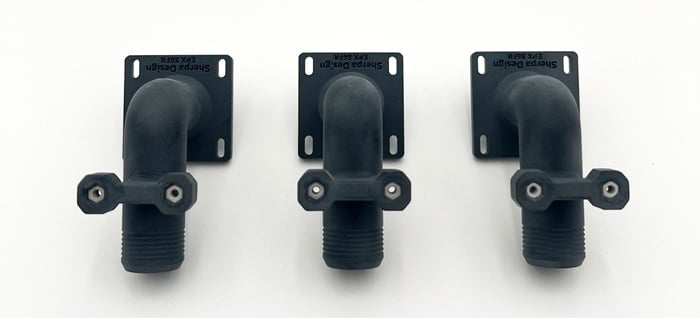 Carbon 3D Printed manifolds for cable and air management in clean rooms
Carbon’s EPX 86 is a rigid resin that possesses a V-0 fire retardant rating and is easy to clean.
Flame Retardancy
EPX 86FR passes UL 94 V-0 @ 2 mm and FAR 25.853(a) vertical burn test @ 1 mm with flame-retardant and self-extinguishing features.
Vertical Burn Test
To qualify for a rating, parts go through a “Vertical Burn Test.” This test method assesses the flammability of a material by subjecting a vertically oriented sample to a controlled flame, measuring critical factors such as self-extinguishing time, afterglow time, damage to the holding device, and any dripping behavior. This test is often used to assess the fire resistance of plastics and textiles and is commonly referenced by the UL 94 standard. Materials are categorized into different levels based on their burning behavior, such as V-0 (most flame retardant) to V-2 (least flame retardant). *
* Flammability rating UL 94 V
| Test Criteria | V-0 | V-1 | V-2 |
|
Burning time of each individual test specimen (s) (after first and second flame applications) |
≤10 |
≤30 |
≤30 |
|
Total burning time (s) (10 flame applications) |
≤50 |
≤250 |
≤250 |
|
Burning and afterglow times after second flame application (s) |
≤30 |
≤60 |
≤60 |
|
Dripping of burning specimens (ignition of cotton batting) |
no |
no |
yes |
|
Combustion up to holding clamp (specimens completely burned) |
no |
no |
no |
Cleaning and Durability
In addition to fire retardancy, the parts needed to withstand frequent cleaning without sustaining damage or degradation.
The EPX family of resins, particularly the EPX 86FR variant, is highly resilient to solvent exposure. EPX 86FR shows no surface blemishes and minimal change in tensile properties after chemical exposure simulating splash contact per USCAR-2 conditions.
EPX 86FR Chemical Compatibility
| Mass Gain (%)** | |
| Household Chemicals | |
| Bleach (NaClO, 5%) | <5% |
| Sanitizer (NH4Cl, 10%) | <5% |
| Distilled Water | <5% |
| Sunscreen (Banana Boat, SPF 50) | <5% |
| Detergent (Tide, Original) | <5% |
| Windex Powerized Formula | <5% |
| Hydrogen Peroxide (30%) | <5% |
| Ethanol (95%) | <5% |
| Industrial Fluids | |
| Engine Oil (Havoline SAE 5W-30) | <5% |
| Brake Fluid (Castrol DOT-4) | <5% |
| Transmission Fluid (Havoline Synthetic ATF) | <5% |
| Engine Coolant (Havoline XLC, 50%/50% premixed) | <5% |
| Diesel (Chevron #2) | <5% |
| Skydrol 500B-4 | <5% |
| Strong Acid/Alcohol/Base | |
| Sulfuric Acid (30%) | <5% |
| Sodium Hydroxide (10%) | <5% |
**Percent weight gained after one week submersion following ASTM D543. Values do not represent changes in dimension or mechanical properties.
USCAR2 Fluid Resistance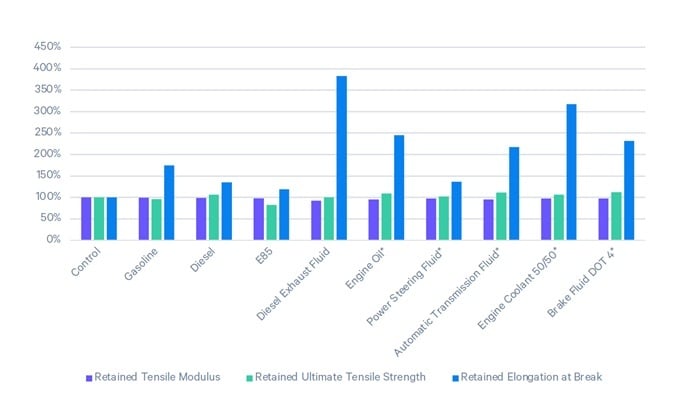
Treatment Method: Samples submerged in test liquid for 30 minutes at 23 °C or 50 °C (starred) then removed from test liquid and allowed to sit at ambient room temperature conditions for 1 week (samples were not wiped).
Test Method: ISO 527-2, Type I, 5 mm/min
Process and Outcome
With CAD files from the semiconductor customer in hand, Sherpa made some necessary DFAM changes before commencing the printing process.
We optimized print quality, running them on our new M3 printers. We ran parts through the smart part washer, then baked them to improve functional toughness and impact strength of EPX 86FR. We worked with our proprietary insert design guidelines to install stainless steel hex-shaped inserts for improved thread durability.
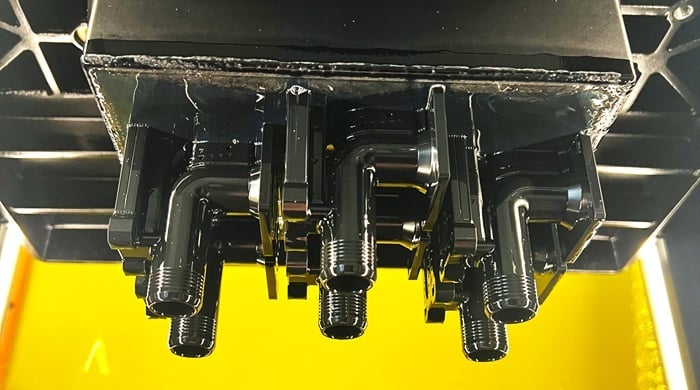 2.5 hour print duration on the Carbon M3
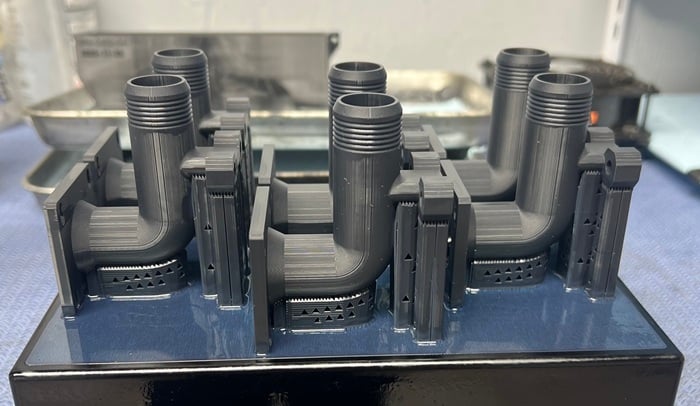 The Carbon Smart Part Washer ensures consistent part accuracy and material properties
Following in-house standard operating procedures and quality control, the initial batch was delivered to the client for testing and subsequent installation.
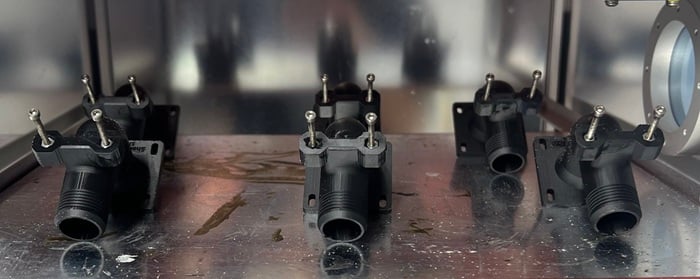 Stainless steel hex-shaped inserts are installed for improved thread durability
The successful outcome of the project not only met client expectations, it validated the use of Carbon EPX 86FR for the development of fire-retardant UL 94 V-0 additive manufacturing parts for semiconductor manufacturers.
Interested in designing Carbon additive parts for your clean room?
